

How CFOs Can Help Sales
(without being too annoying about it)

No Good Deed Goes Unpunished
If you’re a VP of Finance or a CFO, you’re eventually going to get deputized to help one of your teammates with something analytical.
Sometimes it’s product. Sometimes it’s customer success.
But pretty often, it’s sales.
“Sales feels a little too hard to understand right now,” your CEO tells you. “Can you spend some time with the team and help us figure out what’s going on?”
You say yes. Then you pull some reports. You look at the forecast. You stare at the pipeline. You ask a few reasonable questions about coverage, conversion, win rate, sales cycle, average deal size, discounting, quotas, and comp plans.
And then you run into the first real problem: the numbers that you assumed would be easy to get are actually not that easy to get.
Some of the numbers live in the CRM, but the CRM is kind of a mess. Some of them live in a spreadsheet on a sharepoint drive that someone built last year and nobody has looked at since. Some of them are actually pretty easy to grab, but everyone defines them differently. (Ever asked about something simple like conversion rates and then gotten immediately sucked into a wormhole? I certainly have.)
It’s pretty easy to tell whether the team hit or missed the number. But you still cannot answer the more useful question: what, specifically, caused the result, and what do we need to do to get better?
This is when your job as finance leader gets delicate.
Because your questions are reasonable. But unless they’re framed appropriately, they can also be… a little annoying?
This isn’t because sales leaders are fragile or allergic to accountability (ok, sure, a few are). The issue is that the questions finance leaders like to ask usually land right on top of the high-pressure work the sales leader is already doing.
Why did this deal slip? Why did that rep miss? Why did conversion get worse YOY? Why does the forecast say one thing while the pipeline report suggests something else? Why do we keep discounting late? Why do we have 3.2x coverage and still feel nervous about the quarter? Why why why?
Look, those are fair questions. They are also questions that can make a sales leader feel like they are being audited by someone who does not have to carry the emotional weight of convincing a bunch of messy, complicated human beings to contractually agree to pay your company tens of thousands of dollars every 90 days.
This is the fundamental tension between finance and sales.
You want to understand the business well enough to help it grow faster. You also do not want to become the finance person who turns every conversation with sales into a deposition.
The ask from your CEO isn’t to whip sales into shape. It’s to help the person running sales make better decisions.
That distinction matters.
Finance can absolutely help sales. In fact, in a lot of growing companies, finance is one of the only functions with the analytical capacity to help sales see what is happening across the whole system. But the help only works if it feels like help to the person receiving it.
Dave Kellogg has a line I’ve always liked:
Help is defined in the mind of the recipient.
It does not matter that your question is reasonable if the sales leader experiences it as criticism. It does not matter that your analysis is right if nobody uses it to make a better decision. And it does not matter that you are trying to help if the person you are trying to help feels like they are being put on trial.
A better, healthier, more productive version of this relationship is possible. Finance can absolutely help sales understand the business more clearly, make the budget more useful, improve forecasting, clean up the data that matters, make selling easier, and ultimately build a more predictable, exit-ready business.
But to do that, you, my dear finance leader, have to pick your spots.
So How Should Finance Work With Sales?
This is what my friend CJ Gustafson and I wanted to talk about a few months back. CJ writes Mostly Metrics and hosts Run the Numbers. (Finance leader or not, you should check out both if you haven’t already.)
We’ve done a few podcasts together now, including our last one where we flipped the format and I interviewed him about what it has been like to build a niche media business focused on CFOs.
After that episode, we started emailing about what we should record next. We started telling stories about finance and sales, and how those functions typically interact inside of growing companies.
This was the note I sent him after we kicked around a few ideas.
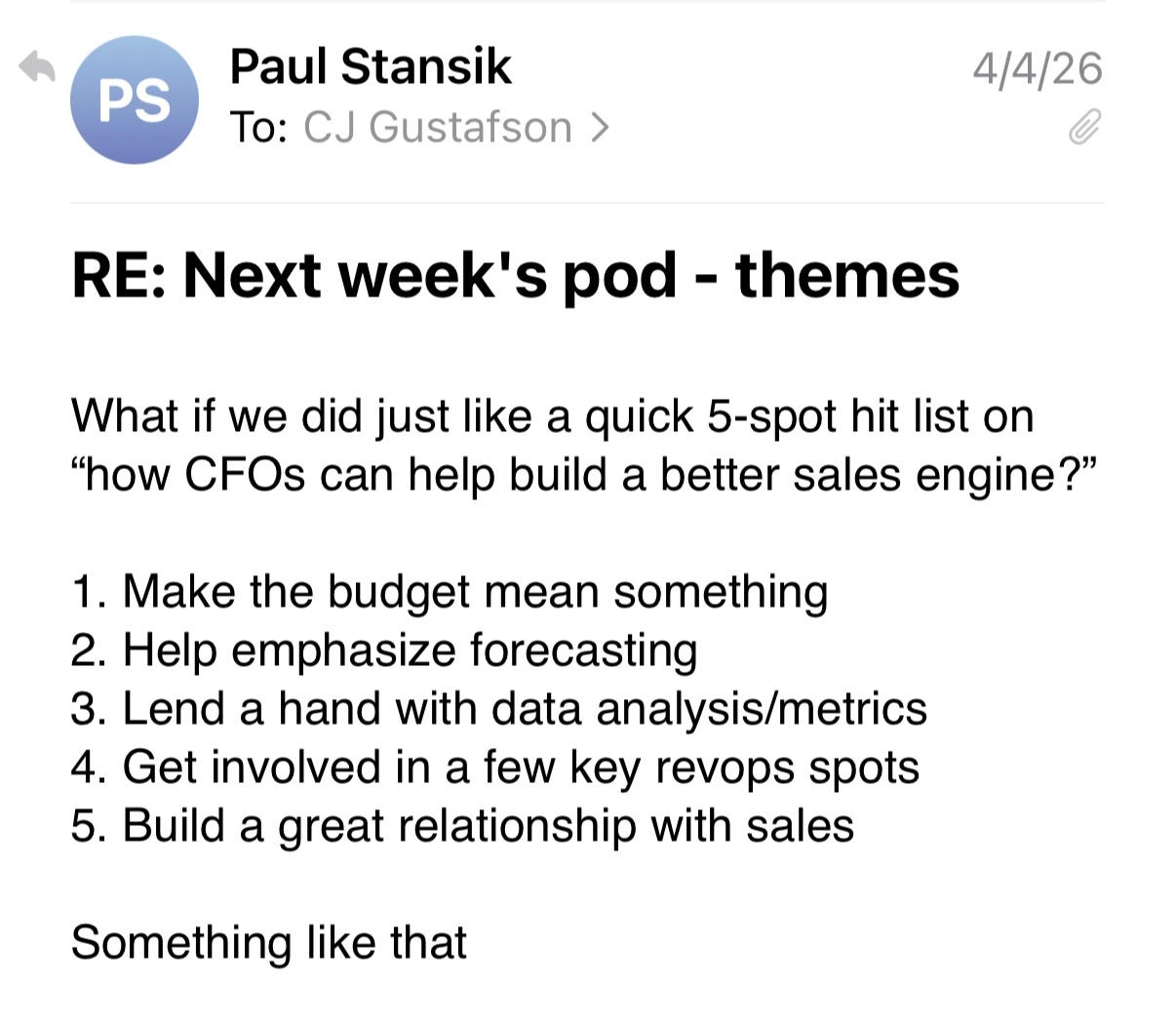
We more or less stuck to that agenda, but also hit on several angles of how to find that balance between rigor and support between finance and sales:
Why the budget process is one of the few key alignment moments that sets up the entire year.
Why forecasting is such a key opportunity for sales and finance leaders to team up.
Why “more data” is usually not the answer, but making the right numbers easier to understand often is.
The short list of specific RevOps problems where finance can be helpful
And why none of this works if the person running sales does not believe you are actually there to help.
You can watch or listen to the full episode here:
Also available wherever you get your podcasts (Apple and Spotify links here).
A few of the best nuggets from our conversation below:
Make the Budget Mean Something
Most could be making a lot more of their budgeting process. Not making the budget more complicated, but using the budget as a tool to create agreement, alignment, and clarity.
Here’s what budget season typically looks like inside of a small, emerging company: Everyone wakes up in September and realizes they have a couple months to put the budget together. Revenue gets rolled into one top-line target. Expenses get negotiated. The leadership team agrees to something that feels achievable enough to defend and aggressive enough to satisfy the board. Then everyone moves on.
The problem is that a budget built that way does not tell you very much once the year starts.
If the whole revenue plan is one number, you have limited your ability to diagnose what happens once the inevitable chaos and lumpiness inside of every business starts to happen. Three months into the year, when the company is tracking behind plan (whether everywhere or within one product, region, or business unit), everyone starts asking the questions they could have started to explore when they built the plan.
Was new logo soft? Was expansion weak? Did one region miss? Did one product underperform? Was the core business fine, but the growth initiative failed? Was the sales team short on pipeline, or did they have enough pipeline and fail to convert it?
If you did not separate those things in the budget, you have to figure them out after the miss. That makes the operating conversation slower and less useful than it needed to be.
The better move is to decide how you are going to segment the business before you build the number. Maybe it is by product. Maybe it is by region. Maybe it is by segment. Maybe it is new logo versus expansion. Maybe it is the part of the business that is supposed to keep performing versus the part of the business you are trying to improve.
The way you break the business apart depends on the situation. The point is that you have to decide on how you’re going to do it before the year starts.
This is where finance can help a lot, because finance is usually the function with enough discipline and distance to force that conversation. You are not just asking, “What number do we need?” You are asking, “What has to be true for this number to happen, and which part of the business is responsible for making that happen?”
That question changes the budget process. It’s what turns the budget from a board document into an operating plan. It also gives the CEO, the sales leader, and the CFO a shared language they can use to talk about performance and what they should do next. That’s huge.
Here’s CJ and me on the simple segmentation move that can make your budget actually mean something.
Lend a Hand With Analysis and Metrics
In a lot of growing companies, finance is the only team with spare analytical capacity. But the best use of that spare capacity is usually not another report.
Sales leaders already have plenty of numbers around them. What they do not always have is someone helping them understand how those numbers connect to the business they are trying to run.
There is a big difference between knowing a metric and understanding it. A sales leader can say “NRR” in a meeting and still not really understand what moves it. They can know the bookings target and still not have a clear picture of how pipeline, win rate, sales cycle, average deal size, ramp time, churn, and expansion all work together. They can know the number and still not know which decision they are actually making when they hire another rep, change territory coverage, or push the team toward one type of customer instead of another.
CJ told a story I liked about this. He had been talking about NRR for a couple of quarters with his sales leader. The sales leader knew the metric mattered. He could repeat it back. He understood, at least generally, that the company cared about it. But it was not changing the way he made decisions.
Then CJ sat down with him and walked through the actual pieces underneath the number. What drives expansion. What drives contraction. What happens when churn improves. What happens when one customer segment grows faster than another. What happens to the P&L when the company hires ahead of demand or waits too long to add capacity.
Same metric. Different conversation.
After that, the sales leader started connecting his own decisions back to the number. Hiring decisions. Coverage decisions. Customer focus. The metric became useful because someone had done the work to make it understandable to him.
That is a much better, more useful job for finance than producing a cleaner version of the same dashboard.
Do not just tell the sales leader what the number is. Show them why it matters. Show them what changes it. Show them how the decision they are making this week shows up in the P&L this quarter and in the value of the company later.
As I’ve written before:
Once you start having a human conversation about the data with your sales leader, you put them in a position to use that data to improve their part of the business. That’s what real help is. That’s what you’re going for.
A little more from me and CJ on that topic below.
Get Involved in a Few Key Revops Spots
RevOps is another place where finance can help, but only in a few specific spots.
You do not need finance involved in every CRM field, workflow, dashboard, and process debate. That is how a potentially useful partnership turns annoying fast.
But there are places where finance should care because the RevOps problem eventually shows up in the numbers. I I think pricing and quoting is a fantastic place to start.
This is where a lot of sales momentum gets wasted. The discovery call goes well. The demo goes well. The buyer is interested. They ask the obvious next question: “What does this cost?”
And then the company makes that question hard to answer.
The rep needs approval. The package is unclear. The discount rules are not written down. Nobody is totally sure what the customer should buy. The quote takes too long. Legal gets involved too late. Two weeks go by. The buyer who was ready to talk pricing is now busy with something else.
That is not a sales mystery. The company made it too hard for the buyer to keep moving.
This is a good place for finance to get involved because it’s a complex area that sits at the intersection of sales, pricing, packaging, margin, approval rights, and risk. The goal is not to make quoting more controlled for the sake of control. The goal is to make the business easier to buy from.
What do we sell? How is it packaged? Where can reps negotiate? Where can they not? What requires approval? What should a rep be able to quote without asking anyone? What terms create problems for the business later?
Answer those questions and you remove a real source of friction from the sales process and meaningfully improve win-rates. The sales rep can respond faster with more certainty. The buyer gets a clearer picture of what they’re buying (which makes it easier to advocate for internally). The sales leader gets shorter sales cycles. Finance gets fewer strange end-of-quarter deals with big discounts, custom terms, and weak explanations for why “we had to do it this way.”
Here’s CJ and me with more on the revops problems that finance should be focused on.
Check out the full episode with CJ and I here on YouTube, Apple, and Spotify.
And if you’re a finance leader, go ahead and subscribe to Mostly Metrics. You’ll be glad you did.
here's a narrative that follows finance people everywhere, that we only care about numbers while the human cost sits somewhere off screen. I read an article yesterday about how private equity owns close to 20% of the companies people interact with daily and how that model basically requires extraction to work. It's hard to argue with sometimes. But reading this and coming across 'data is only as good as the conversation it creates' made me think that maybe the problem was never finance people. It's when we stop presenting data in a way that holds a conversation and just hand someone a set of graphs and walk away
really interesting topic, Paul. per usual, you include the human element, too. You missed a big factor here, though: sales leaders, like anyone, need to want to be helped.