
How To Get Started With Demand Generation
(Without overcomplicating it.)

I’ve been working with nearly all of our portfolio companies on something related to their marketing strategy over the last few quarters. And while doing that work, I kept feeling this interesting tension.
On the one hand: the basic stuff that marketing teams should be doing to generate pipeline really aren’t that hard. On the other hand: a lot of businesses genuinely struggle with how to get started, or they get going but then fall out of rhythm after a month, or they agonize over what to talk about and how to measure the results and then sort of lose momentum and move onto a different marketing channel they read about over the weekend.
It’s a lot like fitness. Some people struggle to start working out. Some people struggle with going to the gym consistently. But everyone struggles with some part of building and keeping the habit, especially at the beginning. And we all make it harder by overthinking things and succumbing to training ADD. There’s always something else to try. (That’s both part of the fun and part of the problem.)
When I start to do lots of work within a topic like this (one where I feel like I understand “how to do the basics well” but notice lots of conflicting opinions and unnecessarily-confusing jargon related to it) my instinct is to (a) try and write down what I believe and (b) see how simple I can make it.
So the other day, I ripped a notecard off the pile on my desk and wrote down the four coaching points I keep repeating with my companies during these marketing projects.
Then I took a picture, wrote a short LinkedIn post, and hit publish.
The response was immediate.
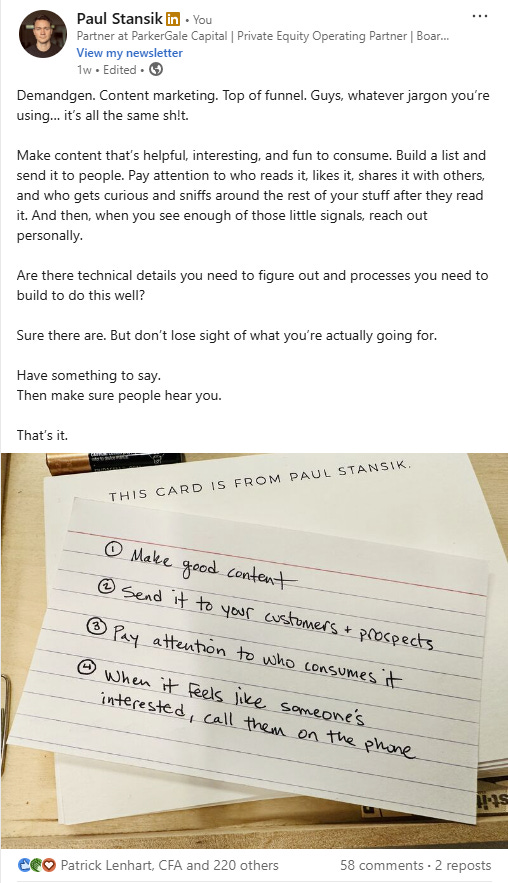
I wouldn’t exactly call these numbers “blowing up”, but the level of engagement relative to other recent posts of mine was hard to ignore. This thing struck a chord. People saw themselves in it. If I had to put into words what resonated with them, I think it was something like:
Oh right, I already know what I’m supposed to do. It’s just that we tend to overcomplicate this and I needed someone to say the simple version of what we’re actually going for here out loud.
There’s a lot of marketing/content/demand generation stuff you can do to create leads for your business. Paid ads, retargeting, content, intent signals, influencer programs, SEO, answer engine optimization, and a couple dozen other tactics and channels that genuinely work when you do them well.
But if you’re just getting started, especially if you’re building marketing out from scratch, and if you’re looking for the highest ROI on a simple way to start talking to your potential customers and generating pipeline, here’s where I think you should start.
1. Make Good Content
There’s a lot of bad content marketing out there. Especially in my world of B2B. You should strive to create good content. Good content stands out.
But what makes good content good?
I believe good B2B content has two qualities:
It answers questions people care about.
It’s enjoyable to consume.
1. Answer Questions People Care About
Quality #1 (answering the right questions) is all about research and understanding your customer. You gotta get to know the people you’re selling to. How do you do this? You listen. You talk to your best customers. You read your company support tickets. You sit in on sales calls.
The questions these people are asking are already there. You just have to recognize the pattern.
Here’s the kinds of customer questions you should listen for and think about answering in your content.
“Do we have a problem?”
This is where customers realize they have a problem. They’re trying to understand what’s going wrong and why it keeps happening.
“Why does our [process] always break down at [specific step]?”
“What are the signs we actually need to fix this?”
“What is this problem costing us?”
“Is this problem just us, or is everyone dealing with this?”
“Why is this so hard? Why can’t we get [outcome] no matter what we try?”
“What are my options?”
Once the problem is clear, they want to know what solutions exist and understand the real tradeoffs between them.
“Should we build this ourselves, buy [product], or just hire more people?”
“What are the 3-4 ways people like me solve this problem?”
“What’s the real difference between [your category] and [adjacent solution]?”
“Which approach makes sense for a team our size/shape?”
“Why you?”
They’re narrowing their options. Now they want to understand what makes each approach different and why they’d pick one over another.
“Why would I use [your product] instead of just using [adjacent tool] better?”
“What’s the actual tradeoff between [your approach] and [common alternative]?”
“How is this different from what [competitor] does?”
“Why did you build it this way instead of [other way]?”
“What happens if I buy?”
Further down the path, now they’re close to deciding. These questions are all about seeking proof that this actually works and clarity on what success looks like.
“Can this actually eliminate [time-consuming process] or just make it faster?”
“What kind of improvement should we realistically expect?”
“Who has already tried this and what results have they gotten?”
“How long until we’d see [specific result]?”
“What does success actually look like with this?”
“How much work is this going to be to implement?”
“What’s changing?”
This one doesn’t neatly fit into the buying journey, but great content isn’t always about shepherding someone through a purchase decision. Sometimes it’s about “bringing the outside in” and helping people understand what’s going on and how they should think about it. Not directly related to any one part of the buying journey, but a fantastic way to build trust and establish authority.
“Is [regulation/trend] going to force us to change how we do this?”
“Should we be worried about [competitive threat/market shift]?”
“What are companies like us doing about [industry change]?”
“How should we be thinking about [trend]?”
If you sit down and start to think about this question-based approach to content, you’ll soon realize that there are infinite questions you could be answering for your customers. Learning to think in questions (and answer them one at a time) is the #1 thing that will help you create better content. Because, as HBS professor Clayton Christensen once said:
“Without a good question, a good answer has nowhere to go.”
If you like this question-and-answer approach to content creation, I highly recommend the book They Ask, You Answer by Marcus Sheridan. It’s the book for learning this approach to customer obsession—and there are tons of great examples inside re: how you can apply this philosophy to any business. Marcus and I also did a podcast episode together a while back and had a lot of fun doing it.
2. Make It Enjoyable To Consume
The second quality (making your content enjoyable to consume) is a little harder to teach. How do you make stuff people want to read, watch, or share with others? What does enjoyable even mean?
My take: Enjoyable content (especially in B2B) respects people’s time. It’s clear. It’s linear. It builds. It pulls you in, hand-over-hand, using good structure and by opening and closing loops in a satisfying way. It feels finished. The rough edges and distracting bits and jarring transitions have all been sanded off.
A good editing trick: read the thing you’re writing out loud (or watch the video you’re making) and notice where you start to get bored. That’s where the problem is. That’s where you’re not respecting people’s time. Fix that part.
An even better trick: Whenever possible, take a written piece of content and turn it into video. Record the answer instead of writing it. There’s all kinds of reasons to do this. One: Most people literally do not read anything anymore. Two: It humanizes you. They can see that this is a real person who actually knows what they’re talking about, who’s putting themself out there in a way that written content just doesn’t demand. A three-minute video explaining how your product works will almost always get watched more than a 1,500-word blog post saying the exact same thing.
And yes - AI can be a HUGE help for creating high-quality content, if you use it in the right way. Here’s three prompts I use all the time (and a lot more here) to take something that’s nearly done and turn it into something polished. Something I’m proud to publish.
AI Prompt #1 - Find The Waste: I want you to go through this like an editor with a red pen—cut filler, redundant points, weak transitions, or anything that doesn’t move the argument forward. Highlight where I’m repeating myself, where I could say something in half the words, or where the energy drops. Then rewrite a tighter version without losing clarity or personality.
AI Prompt #2 - Turn The Dial: I want you to go through this and identify which sections need the volume turned up (more vivid, more confident, more emotionally resonant) and which ones should be turned down (quieter, tighter, less try-hard). Then show me what that calibrated version looks like, with pacing, tone, and emphasis adjusted for maximum impact without losing the voice.
AI Prompt #3 - The Tough Critic: Imagine you’re a [insert target audience] who is busy, skeptical, and has seen a hundred versions of this before. Rewrite the message to grab their attention fast. Cut anything that sounds generic or fluffy, avoid trying too hard to persuade, and frame it in a way that speaks directly to what they care about.
If you’re looking for more thinking on what makes good content good, I highly recommend Nobody Wants To Read Your Sh!t by Steven Pressfield. It’s the wakeup call you need to find the boring parts in your content and kill them with fire.
2. Send It To Your Customers and Prospects
If you’re reading this, I want you to take an oath with me. Ready?
I will stop just posting the stuff I create to my company Linkedin page and then calling that marketing.
Good job. You’re better than that.
Here, I'll prove it to you. Go check your LinkedIn impressions on the latest post from your company account right now. (I'll wait.)
If you're an emerging tech business—call it $50M ARR or under—I'll bet you're seeing a couple thousand impressions per post, maybe less. Let's think about what that number actually means. Of those 1-2K people that saw your post, a lot of them aren't your ideal customer profile at all. Let's say 50% aren't. They're just randos that happen to see you pop up in their feed. If you got 1K impressions, and 50% are in your market, that means maybe only a few hundred relevant people catch a glimpse of your post while speed-scrolling their feed, get counted as an impression, and keep going about their day.
Should you still post stuff to LinkedIn?
Sure. Don't not do that. Every impression counts.
But you need more than that. You need insurance that the people who matter actually see your stuff.
Email is the simplest form of that insurance. We all use it. We all check it a billion times a day. And it’s the cheapest, simplest way to amplify the good stuff you’re creating and give it a fighting chance of being read by someone who might actually buy something from you someday.
To do this well, you need to build some lists. Start with two lists:
For customers: Start with knowing who pays you money and making sure those people are in a system of record you can send from. Sounds basic. Surprising number of companies don’t have this buttoned up.
For prospects: Align on your ICP, build a list of the right people/titles inside those companies, use a data provider to get contact information, load it into your system, and send responsibly.
That last part matters more than people realize. Cold email at any volume puts your domain reputation at risk. Here’s the short version of how to protect yourself: never cold email from your primary domain. Set up a subdomain (yourcompany-mail.com works fine), warm it up over 3-4 weeks by gradually increasing send volume, and rotate between a couple of mailboxes so no single address takes the full hit. There are plenty of tools out there that can handle this automatically for you.
Think of this like breaking in new running shoes. You don’t wear them for a marathon on day one. You need to put some miles on them first.
3. Pay Attention To Who Consumes It
This is where you need a little help from RevOps. Not a lot, just enough to make sure you’re noticing the right signals.
I’ll use myself as an example. After every Substack post, I go into my stats and check who read it. If I see a cluster of reads from one person, I know one of two things: either they have a giant crush on my writing, or they probably sent it to someone else. Either way, that’s a signal. Something I wrote resonated with them. My message landed.
My newsletter is a bad example in one sense—it’s free, and I don’t really have anything to sell off the back of it (not yet anyway). But here’s a very basic thing I do with those signals: if I’m not connected with that person, I send them a connection request. “Thanks for reading today’s post on [X], just putting a face to the name.” I want them seeing more of my stuff, telling their friends, maybe introducing me to someone useful down the road. It happens one person at a time.
That’s the workflow: Create. Ship. Notice. Connect.
And that’s what this should feel like if you’re a business. And even with basic sales and marketing tools, you have far more signals to work with (and far more potential connections to create) than I do on Substack. When marketers talk about lead scoring, this is what they mean. Building a list of signals you can track, then deciding how much weight to give each one.
Here are the signals worth paying attention to, roughly in order of how seriously to take them:
Filled out a form — someone completed a contact or demo request. Obvious one, but it’s the ceiling, not the floor.
Forwarded your email — a prospect shared a marketing or sales email with someone else in their org. This is a big deal. It means internal conversation is happening.
Multiple page views in a short window — someone visited your site several times in a few days. That’s research behavior, not browsing.
Opened a sales email 3+ times without replying — they’re reading it, probably sharing it, and haven’t said no.
Visited your scheduling/demo page but didn’t book — got close, got cold feet, still interested.
Opened marketing nurture emails repeatedly — not a hot signal on its own, but a pattern worth noting.
Connected with you on LinkedIn — low intent but warm. They know who you are now.
Found you through an AI tool — if someone discovered you via ChatGPT or another LLM, they were doing specific research. Worth paying attention to.
If your RevOps person is good, they will have opinions about how much weight to give each signal. Let them. It’s a fun and productive argument to have.
4. When It Feels Like Someone Is Interested, Call Them On The Phone
I chose those words (”call them on the phone”) very carefully.
Email is a great way to make sure people see your content. But in my world of B2B, it is increasingly not a great way to convert those people into meetings or paying customers. We’ve become numb to it, and the AI-generated spam cannon we’ve built for ourselves over the last decade has made the problem worse. Your prospects are drowning in “just wanted to circle back” and “can you at least point me to the right person” and they are hate-not-replying to all of it.
Here’s the fix: Call them, and don’t be weird about it. Reference what they’ve been engaging with without being a creep. You don’t need to open with “I noticed you visited our pricing page at 2pm on a Tuesday.” Ask permission to take two minutes. Make those two minutes good. And if the answer is “not now,” let them know you’ll plan to hang around the hoop (again, without being weird about it) so when the problem you solve becomes real for them, they know who to call.
What does “don’t be weird about it” actually mean? It means you acknowledge you can see what they’ve been looking at without making it sound like surveillance. Something casual like: “Our fancy tech stack tipped me off that you might be doing some research on our category—figured it was worth a quick call to see if I could answer any questions and maybe share an educated guess on how we might be able to help?”
That’s interruptive but at least kinda normal. “I noticed you spent 47 seconds on our integrations page last Thursday, can we now book a demo?” is not.
Final Thoughts
The goal of content marketing or demand generation or whatever term marketers decide to invent next week for this thing we’re talking about isn’t to generate immediate pipeline. Most people in your market aren’t ready right now. The goal is to become the most familiar, most trusted voice in your category so that when they are ready, they call you first.
How do you do that? You make good content, get it in front of the right people, notice who’s paying attention, and pick up the phone and say hello when you see your opening.
Are there technical details you need to figure out and processes you need to build to do this well? Sure there are. And yes, there are a few bits that are a little complicated that you have to get right.
But don’t lose sight of what you’re actually going for here.
Have something to say. Then make sure people hear you.
That’s it.
It's not hard, people. It's not easy, but it's not that hard.
so good!